In modern industrial facilities, process safety management is heavily reliant on advanced consequence analysis tools. Chief among these is DNV Phast, the industry standard for modeling discharge rates, atmospheric vapor dispersion, fire risks, and explosion hazards. Process safety professionals rely on these mathematical engines to protect lives, meet regulatory obligations, and optimize hazardous facility layouts.
However, as engineering teams model an increasing number of accident scenarios for Quantitative Risk Assessments (QRA), a major operational hurdle emerges: handling the massive influx of raw simulation data.
To prevent manual data entry from bottlenecking critical project timelines, forward-thinking engineering firms are shifting toward building custom automation layers around Phast. Here is how software developers and system architects are modernizing industrial safety workflows.
Overcoming the Manual Bottleneck in Consequence Analysis
Running a single scenario in Phast is straightforward. An engineer defines the hole size, fluid properties, operating temperature, and weather conditions. Within seconds, the software maps out the dispersion distance, toxic probit, thermal radiation field, or explosion overpressure curves.
The real challenge begins when analyzing large-scale industrial sites. Safety teams frequently have to run hundreds of distinct loss of containment scenarios across variable wind directions, multiple process lines, and different pressure vessels.
When data has to be manually exported, sorted, and re-keyed into internal risk registers, several problems arise:
- Time Friction: Spending dozens of engineering hours copying numeric coordinates from software logs into reports delays plant design approvals.
- Version Control Risks: Keeping track of multiple scenario revisions across separate local files introduces the risk of stale or incorrect data entering the final hazard report.
- Data Isolation: Raw mathematical outputs sit trapped inside standalone calculation reports instead of being dynamically accessible to other critical systems, such as emergency response dashboards or plant information models.
The Power of Custom Engineering Pipelines: The Phast API
The modern solution to this problem is programmatic automation. Recent versions of Phast feature dedicated Application Programming Interfaces (APIs), allowing software engineers to interact with the modeling engine directly through code using languages like Python or .Net.
By developing custom software tools that interface with the Phast API, freelance developers can help safety teams achieve true operational efficiency:
1. Automated Batch Input Scripting
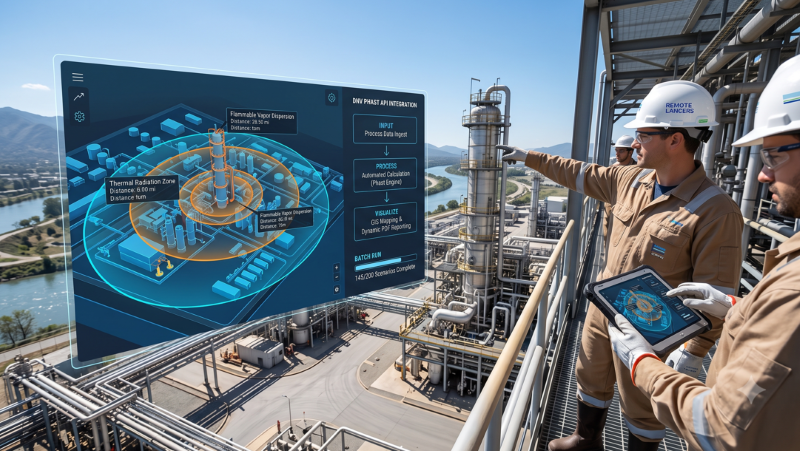
Instead of setting up hundreds of release scenarios by hand in the user interface, developers can build lightweight web applications that ingest Excel or JSON plant data sheets. The script dynamically populates the parameters, launches the Phast engine in batch mode, and handles the calculations simultaneously.
2. Real-Time GIS Data Mapping
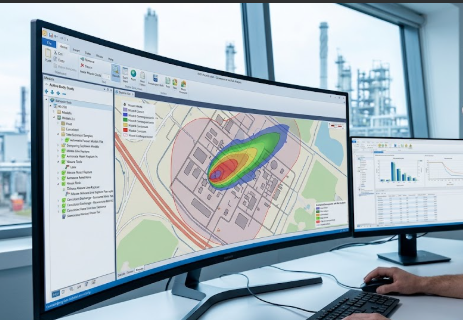
Raw numeric coordinates are difficult to parse during a critical safety review. Custom web solutions can extract the geometric hazard contours directly from Phast's outputs and overlay them instantly onto interactive geographic maps or 3D plant layout blueprints. This gives operational stakeholders an immediate visual understanding of safety exclusion zones.
3. Dynamic Compliance Reporting
Regulatory safety documentation requires absolute precision. Instead of copy-pasting tables, custom backend tools can pull real-time results directly from the simulation database to auto-generate fully formatted, auditable engineering reports or clean, dynamic PDFs ready for regulatory submission.
Building Scalable Architecture for Industrial Safety Tools
When creating custom layers for process safety tools, performance is paramount. Computational fluid dynamics (CFD) extensions and multi-scenario runs require substantial processing power and rapid database synchronization.
Modern web architectures—utilizing fast front-end frameworks like Next.js for distraction-free UI design, alongside highly responsive database backends—ensure internal safety platforms load instantly and sync seamlessly across localized network servers.
By moving past manual data handling and investing in tailored automated pipelines, engineering firms can significantly reduce project overhead while improving the absolute accuracy of their risk modeling.
Looking to automate your engineering workflows, integrate custom software APIs, or build secure data pipelines for your technical infrastructure? On RemoteLancers.com, you can connect directly with experienced freelance full-stack developers, backend engineers, and data automation experts who specialize in building robust internal tools. Post your project scope today to hire specialized remote talent ready to execute clean, production-ready applications.